
Polymarket Live Markets
Example Market
Polymarket Prediction Review: The World's Biggest Market

If you've spent any time researching prediction market apps, you've already heard of Polymarket. It's the largest decentralized prediction market in the world by trading volume, reportedly hitting $9 billion in 2024 alone, and it runs on something entirely different from what you'll find on regulated U.S. exchanges. After spending time on the platform myself, I can tell you it's genuinely impressive in scope but comes with real-world friction that you need to understand before you add funds. What makes Polymarket stand out is the sheer breadth of live markets, the non-custodial wallet model giving you full control of your USDC, and the razor-thin fee structure on most markets. The catch? Its regulatory standing in the U.S. is still evolving, and the onboarding process is a world away from what you'd experience on a platform like Kalshi.
Table of Contents
- Polymarket Signup Bonus & Promo Code
- Available Markets at Polymarket
- How Trading Works on Polymarket
- Polymarket vs Kalshi
- Deposit & Payments
- Fees & Pricing Structure
- One of the Best Prediction Market Apps Around: Destop vs Mobile Review
- Restricted States & Availability
- Is Polymarket Legit?
- Customer Support
- Polymarket Real Player Reviews
- What I Thought Trading on Polymarket
- Final Score
Grab a Polymarket Bonus Now
Here's the honest truth about Polymarket's welcome offer: there isn't one. Unlike regulated U.S. exchanges, Polymarket does not run a traditional signup bonus, no promo code, no matched trade credit, and no free contract to get you started. The platform is venture-backed and relies on low fees and high liquidity to attract traders rather than introductory promotions. If sign-up bonuses are important to your decision-making process, check our list of the best prediction market apps.
Available Markets at Polymarket
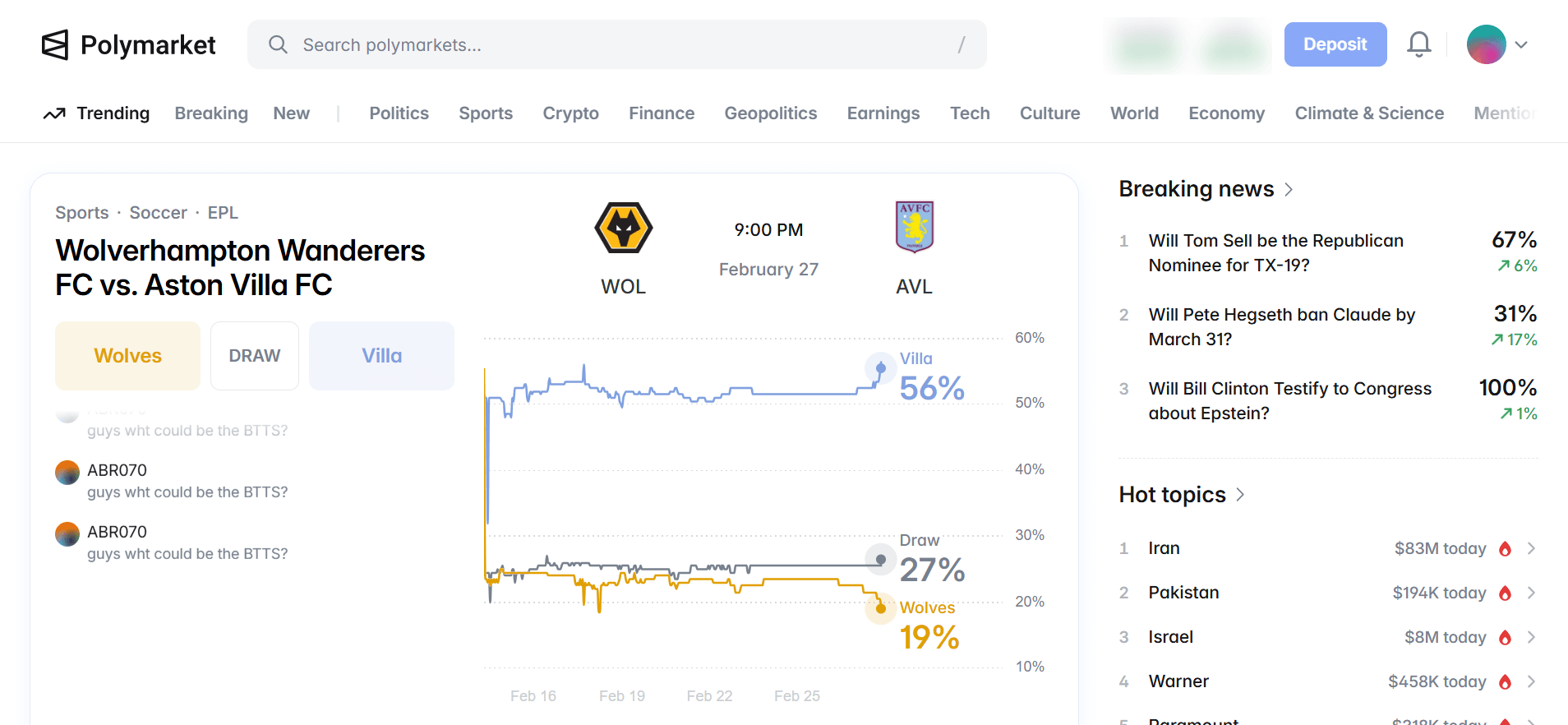
This is where Polymarket earns its reputation. With over 1,200 active contracts spanning politics, sports, crypto, economics, entertainment, and technology, it is the deepest market catalogue you'll find anywhere in the prediction market space. Every contract resolves as YES ($1) or NO ($0), priced in USDC, and traded peer-to-peer via a central limit order book (CLOB), so prices reflect real crowd sentiment rather than a bookmaker's line.
- Political Markets: Elections, legislative outcomes, policy decisions. Examples include "Who wins the 2026 U.S. midterms?" or "Will [country X] hold early elections by [date]?"
- Sports Markets: Game outcomes, championship winners, player performance milestones. Examples: "Will the NBA Finals go to Game 7?", "Will Manchester City win the Premier League?"
- Crypto & Financial Markets: Bitcoin price thresholds, ETH milestones, Fed rate decisions. Examples: "Will BTC close above $100K in March 2026?", "Will the Fed cut rates in Q2 2026?"
- Technology Markets: AI product launches, model releases, company milestones. Examples: "Will GPT-5 launch before July 2026?", "Will Apple release AR glasses in 2026?"
- Entertainment Markets: Awards shows, box office outcomes. Examples: "Will [film X] win Best Picture?", "Will Taylor Swift win Album of the Year?"
- Economics Markets: CPI prints, unemployment data, interest rate outcomes. Examples: "Will U.S. inflation fall below 3% by June 2026?"
One thing I noticed is that the market depth on major political and crypto contracts is exceptional, with open interest regularly topping hundreds of millions of dollars on high-profile events. Niche markets can be much thinner, so check the order book before sizing in.
How Trading Works on Polymarket
Trading on Polymarket is fundamentally different from anything you'll do on a CFTC-regulated exchange like Kalshi. Instead of a fiat account, you trade from a self-custodial crypto wallet loaded with USDC on the Polygon network. Every position is a YES or NO contract that settles at $1 if correct and $0 if wrong. You interact with other traders on a central limit order book, placing limit or market orders, and you can exit any position before resolution by selling your shares back at the current market price.
How to Place a Trade
- Connect your self-custodial wallet (MetaMask, Coinbase Wallet, or Rainbow) at polymarket.com
- Browse to your chosen market and read the resolution criteria carefully
- Select YES or NO and enter your contract size
- Choose a limit order (set your own price) or market order (match existing book)
- Confirm the transaction in your wallet, then monitor your position in the portfolio tab
How to Cash Out
- Navigate to your Profile → Wallet → Balance
- If a market has resolved in your favor, click Redeem Winnings on the resolved market page
- If you want to exit early, click Sell Shares to sell back at the current market price
- From your wallet panel, click Withdraw and select the Polygon network
- Enter your external wallet address (double-check the network), confirm the signature — your USDC transfer processes almost instantly on Polygon
- To convert to fiat, send USDC from your wallet to an exchange (Coinbase, Kraken, Binance), convert to local currency, and withdraw to your bank account
Polymarket vs Kalshi
These are the two biggest names in prediction market apps right now, and they're built on completely different philosophies. Kalshi is a CFTC-regulated U.S. exchange operating under federal oversight with fiat funding and a traditional account structure. Polymarket is a decentralized, crypto-native platform where you trade directly from your own USDC wallet on the Polygon blockchain, no account, no custodian, no middleman.
| Feature | Polymarket | Kalshi |
|---|---|---|
| Regulation | CFTC-approved (US product); global platform unregulated | Fully CFTC-regulated DCM |
| Trading Currency | USDC (crypto) | USD (fiat) |
| Funding Method | Self-custodial wallet | Bank transfer, debit card, crypto |
| Trading Fees | $0 on most markets | ~1.2% avg. (maker-taker) |
| Market Count | 1,200+ active contracts | 300+ active contracts |
| U.S. Availability | Waitlist; 3 states blocked or challenged | Broadly available across most states |
| Bonuses | None | Occasional promotions |
| Support | Email only; slow | Email; moderate response times |
The bottom line: if you want the deepest markets and lowest fees and you're comfortable with crypto, Polymarket wins on breadth and cost. If you want regulatory certainty, fiat onboarding, and a cleaner U.S. legal standing, Kalshi is the safer choice, standing as one of the best prediction market sites available. For most newcomers to prediction market apps, Kalshi's familiar account structure will feel far less intimidating than Polymarket's wallet-first setup.
Deposit & Payments
Polymarket is crypto-native, so all funding and cashing out is done in USDC on the Polygon blockchain. There is no direct bank transfer or debit card deposit to a Polymarket "account" in the traditional sense. Instead, you fund a self-custodial wallet and connect that wallet to the platform. Some on-ramp providers (like MoonPay or Coinbase) allow card purchases of USDC which can then be transferred, but those providers charge their own fees independent of Polymarket. Gas fees on Polygon are negligible, typically $0.01 to $0.05 per transaction, but bridge fees from Ethereum to Polygon can range from $3 to $10 depending on network conditions.
| Method | Funding Fee | Cash-Out Fee | Processing Time (Funding) | Processing Time (Cash Out) |
|---|---|---|---|---|
| Direct USDC (Polygon) | $0 (Polymarket) + gas ~$0.01–$0.05 | $0 (Polymarket) + gas ~$0.01–$0.05 | Minutes | Near-instant on Polygon |
| Bridge from Ethereum | $3–$10 bridge fee | $3–$10 bridge fee | 5–30 minutes | 5–30 minutes |
| Exchange Withdrawal (e.g., Kraken) | ~$0.50–$2 exchange fee | N/A (handled via exchange) | 2–10 minutes | Varies by exchange |
| Card On-Ramp (MoonPay/Coinbase) | Varies by provider (~1–4%) | N/A | Minutes | N/A |
Important note: Polymarket itself does not hold your funds at any point. Your USDC stays in a self-custodial wallet that you control. There is no daily cash-out limit imposed by Polymarket, though individual bridge providers and exchanges may impose their own. KYC is not required by Polymarket on the global platform, though geo-restrictions apply by jurisdiction.
Fees & Pricing Structure
Polymarket's fee structure is one of its most attractive features, and it genuinely undercuts most regulated alternatives when you look at the numbers. The vast majority of markets carry zero trading fees. Fees only apply to specific market types: 5-minute and 15-minute crypto markets, NCAAB (college basketball) markets, and Serie A soccer markets (the latter two from February 18, 2026). For those fee-bearing markets, the taker fee peaks at 1.56% at exactly 50% probability and decreases symmetrically toward the extremes, meaning high-conviction trades near certainty incur almost no fee at all.
| Fee Type | Polymarket | Kalshi | PredictIt |
|---|---|---|---|
| Trading Fee | $0 (most markets); max ~1.56% on select fee-enabled markets | ~1.2% average (maker-taker model) | 10% on profits |
| Funding Fee | $0 (Polymarket); third-party on-ramp fees vary | $0 (ACH); 2% debit card | Not publicly stated |
| Cash-Out Fee | $0 (Polymarket); gas + bridge fees vary (~$0.01–$10) | $0 (ACH); $2 debit card | 5% on redemptions |
| Inactivity Fee | None | None | Not publicly stated |
The hidden cost on Polymarket isn't the platform fee, it's the spread and market impact. In thin markets, the gap between the best bid and ask can be wide enough to meaningfully erode your position. For active traders on liquid markets, Polymarket's all-in cost structure genuinely undercuts both Kalshi and PredictIt. If you win $1,000 on Polymarket in a standard market, you keep close to $1,000. The same win on PredictIt would cost you 15% across their two-tiered fee structure.
One of the Best Prediction Market Apps Around: Destop vs Mobile Review
The desktop experience at polymarket.com is clean and intuitive once you navigate the crypto onboarding. The homepage surfaces trending markets immediately, and the left-side category filter makes it fast to browse politics, sports, crypto, and economics without hunting. Market pages load quickly, the order book is visible, and the YES/NO toggle plus size entry is easy to use. Where it falls short is chart depth: the price history is functional but not as detailed as what you'd find on a proper trading terminal, and advanced analytics tools are absent.
The mobile app launched in July 2025 and is available on iOS and Android. The App Store rating sits at 4.8/5 across 29,000 ratings, which looks impressive on the surface. However, recent reviews flag access issues for U.S. users still on the waitlist and occasional discrepancies with cash-out balances, so take that aggregate with some caution. On UX, the app is fast, market browsing is smooth, and order placement works cleanly. I prefer the desktop for active trading where seeing the full order book matters, but the mobile app works well for monitoring positions and placing trades on the go.
Platform usability rating: 7/10. Clean and fast, but the crypto-native model creates real friction for users who aren't comfortable with self-custodial wallets, and the U.S. app rollout is still on a waitlist as of February 2026.
Restricted States & Availability
Polymarket's U.S. availability is the most complicated part of this entire review. The global platform (polymarket.com) historically blocked all U.S. users following a 2022 CFTC enforcement action and a $1.4 million settlement. In late November 2025, Polymarket announced a return to the U.S. via a regulated "Polymarket US" product under CFTC oversight, beginning with sports markets and a waitlist-based rollout. State-level friction, however, is emerging rapidly and warrants close attention.
- ❌ Nevada — A temporary restraining order was issued in early February 2026 after the Nevada Gaming Control Board argued Polymarket's markets closely resemble unlicensed sports betting. Polymarket began geoblocking Nevada users immediately.
- ❌ New York — The state is preparing ORACLE legislation that, if enacted, would prohibit trading on elections and major world events.
- ⚠️ California — Under active investigation by state regulators, who claim Polymarket lacks the necessary licenses to operate in the state.
- ⚠️ Other states — Additional states are anticipated to take similar action to Nevada in Q1 2026. The legal landscape is shifting week by week.
International availability: The global platform operates across much of Asia, Latin America, and parts of Europe. Blocked countries include China, North Korea, Iran, Syria, the United Kingdom, Canada, Australia, France, Russia, and a substantial list of OFAC-sanctioned jurisdictions. Polymarket updates its restricted-country list frequently, so always verify directly via the official help center. For U.S. traders dealing with state restrictions, FanDuel Predicts offers a regulated alternative with cleaner state-level access.
Is Polymarket Legit?
Polymarket is a legitimate platform, but its regulatory story is genuinely complex and that distinction matters for how much risk you're comfortable carrying. On the federal level, Polymarket received CFTC approval in late 2025 for its regulated U.S. exchange product, a milestone its CEO called a "key step for permeating the U.S. financial system." That said, the global platform operates in a legal grey area for some U.S. users, and the ongoing state-level disputes in Nevada, New York, and California add real and evolving uncertainty.
On the security side, Polymarket's non-custodial model is a structural advantage worth understanding. Polymarket never takes possession of your USDC. Your funds sit in a self-custodial wallet that you hold the keys to, meaning there is no centralized pool for a hacker or an insolvent company to raid. Smart contracts are audited, and the Polygon blockchain adds cryptographic accountability to every transaction. The trade-off is smart-contract risk and oracle risk: if the code or the resolution data source contains an error, there is no FDIC equivalent to make you whole.
- Regulatory Oversight: CFTC approval for Polymarket US (November 2025); global platform remains outside traditional exchange registration
- Security Model: Non-custodial (you hold your USDC), smart-contract-based on Polygon; no KYC required on the global platform
- Fund Protection: No FDIC or SIPC insurance; protection comes from self-custody and audited smart-contract architecture
- Responsible Trading: No formal self-exclusion tools or deposit limits visible on the global platform; these features are expected on the regulated U.S. product but not publicly confirmed as of February 2026
Customer Support
Customer support is arguably Polymarket's most significant weakness. There is no live chat, no phone line, and the primary support channel is email-based through their help center. Multiple Trustpilot and Reddit users have flagged slow response times, with some reporting weeks-long waits to resolve cash-out or access issues. The help documentation is reasonably thorough for standard questions around wallets, trading mechanics, and resolution rules, but complex account issues or disputed market resolutions are where the cracks show clearly. I'd rate support quality at 4/10, which is a real concern for a platform processing this kind of volume.
| Support Channel | Availability | Response Time |
|---|---|---|
| Email / Help Center | 24/7 submission | Variable; reported 3–30+ days by users |
| Phone Support | Not available | N/A |
| Live Chat | Not available | N/A |
| Discord / Community | Community-moderated | Varies |
| FAQ / Help Documentation | Always on | Self-serve |
Social Media: Polymarket is active on X (Twitter) @Polymarket. Community discussions on Reddit via r/PolymarketTrading are active and often more immediately helpful for practical troubleshooting than official support channels.
Support quality rating: 4/10. The absence of live chat or phone support is a meaningful gap for a platform of this size handling real user capital.
Polymarket Real Player Reviews
The public reception is genuinely mixed, and I think honesty here serves you better than a curated highlight reel. On the App Store, the aggregate rating is 4.8/5 across 29,000 ratings, which skews positive. On Trustpilot (421 reviews as of February 2026), the picture is considerably more critical, with recurring themes around cash-out delays and market resolution disputes.
"27 days since I'm trying to withdraw. Contacted once, was promised they'll get back to me. Got back with 'was your issue resolved?' question. No resolution in sight." — Trustpilot reviewer, February 2026
"The market manipulation has gotten so unbelievably bad that there's no point putting money in. Rich individuals flipping results last minute for their own benefit and Polymarket does nothing about it." — Trustpilot reviewer, February 16, 2026
"Polymarket UX is getting bad, the app used to feel snappy and now it's laggy in places. The market resolution inconsistency is a real issue." — Reddit user, r/PolymarketTrading, January 2026
To balance that, the platform's large and engaged trading community on Reddit and X speaks to genuine loyalty among experienced users who are comfortable with the crypto-native structure. The complaints tend to cluster around edge cases: large cash-outs, disputed resolutions, and new U.S. users running into access restrictions. For experienced DeFi traders, the day-to-day experience is reportedly much smoother. That said, the recurring pattern of cash-out complaints is worth taking seriously before committing significant capital.
What I Thought Trading on Polymarket
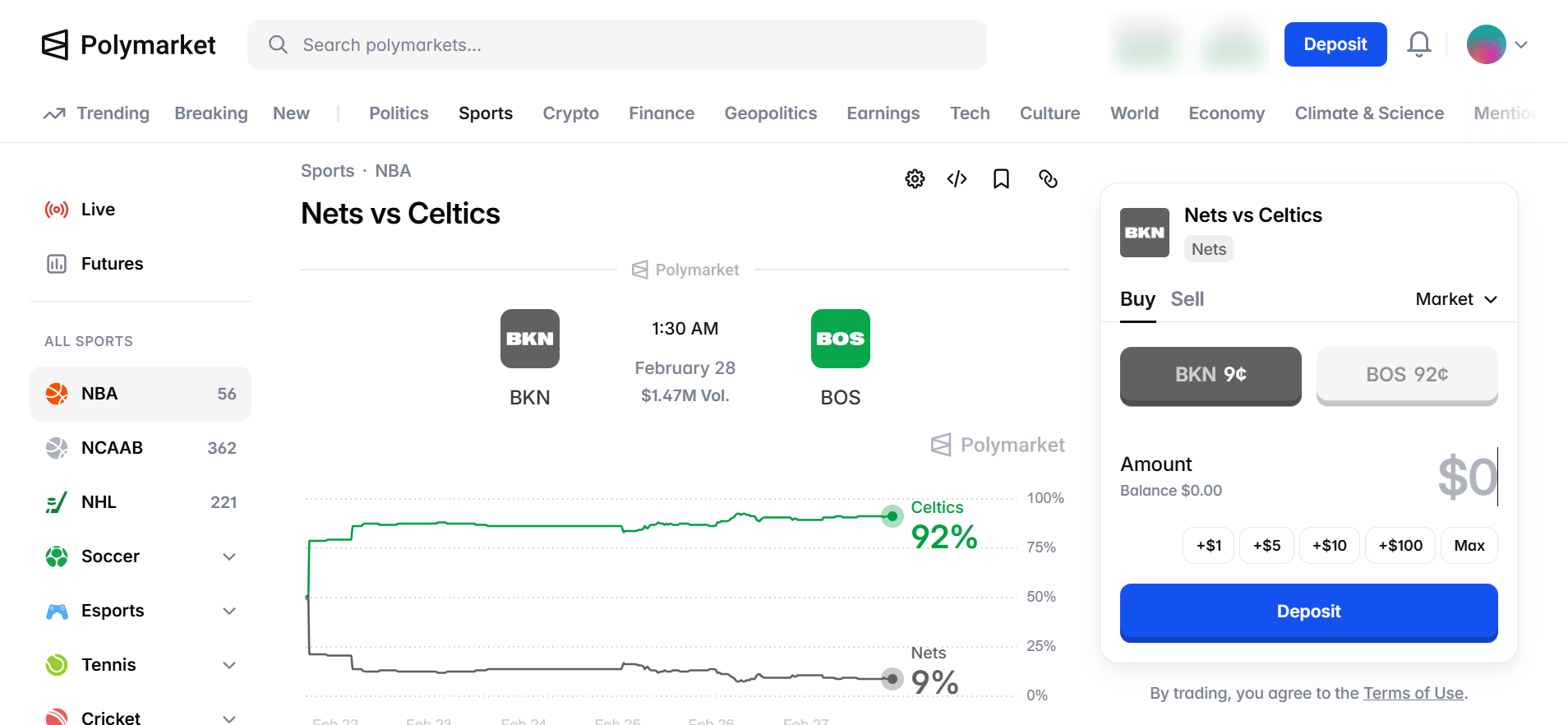
I'll be direct: Polymarket is simultaneously one of the most impressive and most frustrating prediction market experiences I've had. The moment I pulled up a live political market with $50M in open interest, I understood why this platform captured global attention during the 2024 election cycle. The order book is real, prices move on breaking news, and the depth on major events is unlike anything you'll find on a traditional prediction market. Trading a contract at $0.73 on an outcome I had real conviction on, watching it resolve at $1.00, and cashing out in USDC within minutes via Polygon, that core loop is seamless and genuinely well designed.
What I found harder to ignore is everything around that core experience. The onboarding demands more from you than most casual traders are willing to give. Getting USDC onto Polygon requires a crypto exchange account, a bridge, or a third-party on-ramp, none of which are intuitive if you're not already crypto-literate. I also found the market resolution process occasionally opaque. When a market resolves in a way that diverges from your reading of the criteria, there's no clear escalation path and support is painfully slow. For traders coming from a regulated U.S. exchange or a sportsbook, that ambiguity can be genuinely jarring.
My honest recommendation: Polymarket is the right choice for experienced crypto users who want access to the deepest and most liquid prediction markets in the world, particularly for political, macro, and crypto-native contracts. If you're fiat-native or new to self-custodial wallets, I'd steer you toward regulated alternatives until the Polymarket US rollout matures and the state-level legal situation settles into something more predictable.
Final Score: 6/10
Comprehensive, AI driven ratings system:
Funded Peaks rates prediction market apps on a scale of 1-10, covering five basic categories: Bonuses, Markets, Fees, User Experience and Security
If a predictions platform scores 6 or lower on a category, we suggest alternatives for a better experience (orange bubble)
FP Score — Polymarket
FP GOLD
Browse through our top sweepstakes picks


