
Kalshi Live Markets
English Premier League Winner
KALSHI REVIEW: THE CFTC'S PREDICTION MARKET PIONEER
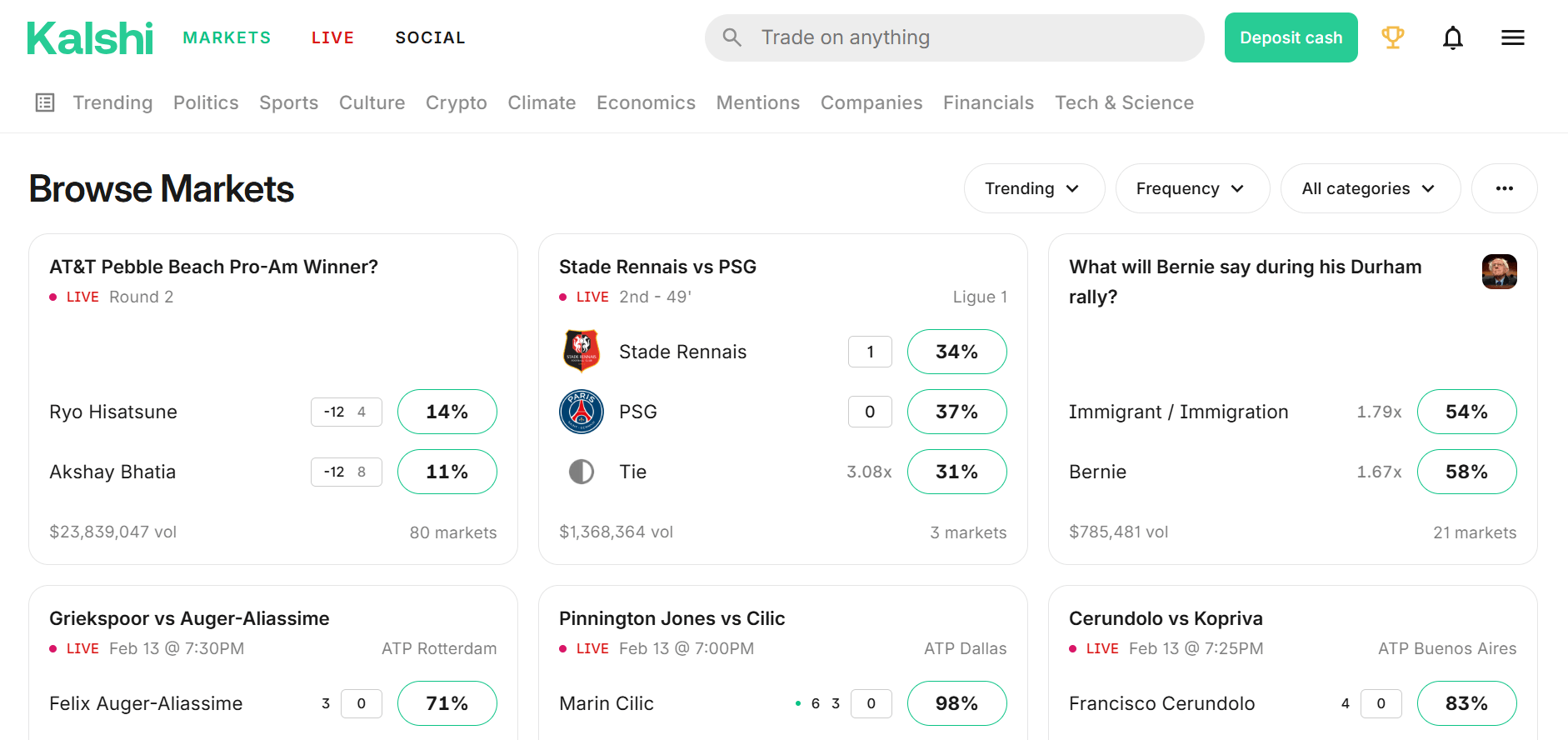
Kalshi is a powerhouse in the prediction markets space for many reasons, but the main ones are the regulatory framework, the exchange-style trading interface, the market diversity spanning sports to economics, and the transparent fee structure. Kalshi operates as the first CFTC-regulated prediction market platform in the United States, offering a legitimate alternative to unregulated platforms where traders can buy and sell event contracts on real-world outcomes. The platform combines the feel of a traditional exchange with the accessibility of modern trading apps, creating a unique space for news-driven traders and beginners alike.
Table of Contents
- Kalshi Signup Bonus & Promo Code
- Available Markets at Kalshi
- How Kalshi Works
- Kalshi vs Polymarket
- Funding & Payments
- Fees & Pricing Structure
- Smooth and Sensible UI: A Look at One of the Best Prediction Market Apps
- Restricted States at Kalshi
- Is Kalshi a Legit Site?
- Customer Support
- Kalshi Real Player Reviews
- What I Thought Trading on Kalshi
- Final Score
Grab a Kalshi Bonus Now
Kalshi offers a straightforward $10 sign-up bonus for new users who complete their first $100 in trades using various promo codes like GOAL, CBSSPORTS, or ELITE. The bonus structure is simple: register for an account, enter the promo code during sign-up, fund your account with at least $1, and trade at least $100 worth of event contracts. Once you hit that trading volume, the $10 bonus is credited to your account. The bonus expires after 30 days and cannot be withdrawn as cash, it must be used exclusively for trading on Kalshi event contracts. Unlike traditional sportsbook bonuses, there are no complex rollover requirements, but the trade volume threshold is higher than some competitors.
| Bonus | Promo Code | Min. Deposit/Trade | Wagering Requirements | Expiration |
|---|---|---|---|---|
| $10 Cash Bonus | GOAL, CBSSPORTS, ELITE, LABS | $1 deposit / $100 in trades | Must complete $100 in event contract trades | 30 days after credit |
Available Markets at Kalshi
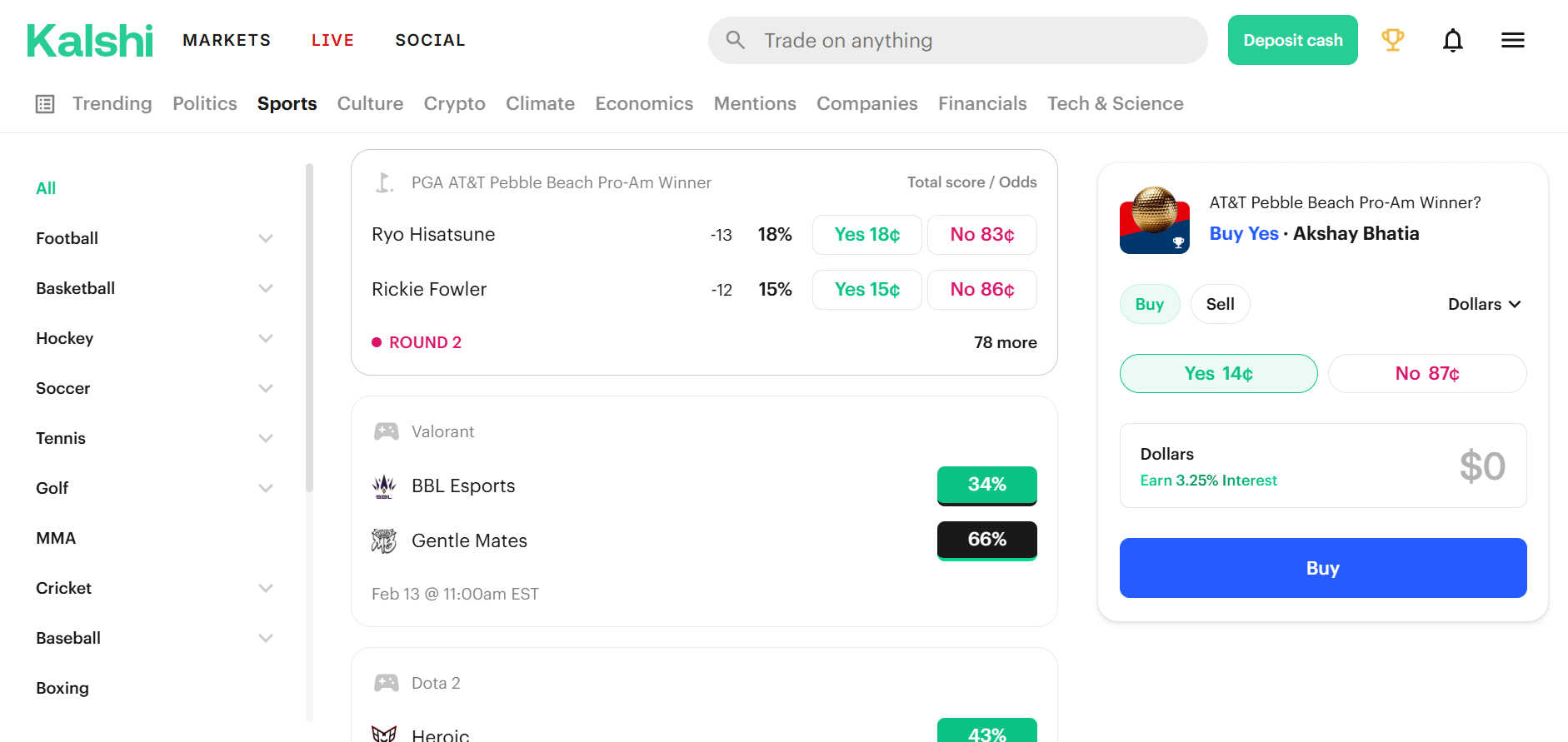
Kalshi offers one of the most diverse market selections even when compared with the best prediction market apps, with hundreds of active contracts spanning multiple categories. The platform currently hosts contracts across sports, politics, economics, entertainment, technology, and even weather events. I've found that market depth varies significantly, with political and economic markets typically showing the strongest liquidity during major news cycles. Sports markets have expanded rapidly but face ongoing legal challenges in certain states.
Sports Markets: NFL outcomes like "Will the Chiefs win the Super Bowl?", NBA game results, NCAA tournament brackets, NHL playoffs, PGA Tour event winners, and Olympic medal counts for the 2026 Winter Olympics.
Political Markets: Presidential election outcomes, congressional control predictions, Supreme Court decisions, state-level races like gubernatorial elections, and international elections including German Bundestag seats and UK parliamentary results.
Economics Markets: Federal Reserve interest rate decisions, CPI inflation readings, unemployment rate thresholds, S&P 500 closing price ranges, Bitcoin price levels, and stock market volatility predictions.
Entertainment Markets: Academy Awards winners for 2026, Grammy predictions, Game of the Year at the 2026 Game Awards, box office performance thresholds for major film releases.
Technology Markets: Company IPO announcements throughout 2026, product launch dates for major tech firms, AI milestone achievements, and tech company earnings reports.
Weather & Climate Markets: Temperature predictions for specific cities, hurricane forecasts during Atlantic season, snowfall totals for major winter storms.
Kalshi reports over 500 active contracts at any given time, though this number fluctuates based on current events and market creation. The platform does not currently integrate with traditional sportsbooks, maintaining its distinct identity as an event contract exchange rather than a bookmaker. If you're primarily focused on crypto-based markets with deeper international access, Polymarket may offer broader coverage.
How Kalshi Works
Trading on Kalshi operates through an order book system similar to traditional stock exchanges. When you place an order, you're either taking an existing bid or ask from another trader, or you're placing a limit order that waits for someone else to match your price. Each contract settles at either $1 (if your prediction is correct) or $0 (if incorrect), creating a straightforward risk-reward calculation. The interface shows real-time bid and ask prices with available contract quantities, allowing you to assess liquidity before entering a trade.
Beyond the order book mechanics, Kalshi charges transaction fees based on your role in the trade—maker fees (when you place a limit order that adds liquidity to the market) are lower than taker fees (when you accept an existing order). The platform supports multiple deposit methods including ACH bank transfers (no fee), wire transfers (no Kalshi fee, though your bank may charge), debit cards (2% fee), and cryptocurrency. When you're ready to withdraw your winnings, ACH transfers remain free while debit card withdrawals incur a $2 flat fee. Importantly, once your contracts settle to their final $1 or $0 value, Kalshi doesn't take any additional cut from your winnings—all fees are applied only at the time of order execution.
Kalshi vs Polymarket

The fundamental difference between Kalshi and Polymarket lies in their regulatory structure and operational model. Kalshi operates as a CFTC-regulated Designated Contract Market (DCM), making it one of the few fully compliant prediction exchanges in the United States with federal oversight. Polymarket, by contrast, is a decentralized prediction market built on the Polygon blockchain network, operating in what some jurisdictions consider a regulatory gray area while focusing on crypto-native traders and Web3 enthusiasts. This regulatory distinction shapes every aspect of user experience: Kalshi uses centralized banking rails accepting debit cards, bank transfers, Apple Pay, and Google Pay alongside crypto options, while Polymarket requires users to connect a crypto wallet and hold USDC on Polygon for trading.
From a practical standpoint, these differences translate to distinct user experiences and fee structures. Kalshi's centralized approach offers plug-and-play banking with familiar deposit methods and a native mobile app, making it accessible to mainstream retail investors who prefer traditional financial interfaces. Polymarket's decentralized model provides on-chain transaction receipts and full transparency through blockchain records, which appeals to users who value decentralization and are comfortable with wallet connections, though Polymarket has also launched a U.S.-focused app with a waitlist system. Fee structures differ as well—Kalshi uses tiered pricing based on contract price and maker/taker roles, while Polymarket targets a 0.01% U.S. taker-fee for its domestic product. Polymarket has also demonstrated significantly higher traffic, recording nearly four times the site visits of Kalshi in early 2026.
Kalshi vs Other Prediction Market Apps
Beyond Kalshi and Polymarket, the prediction market landscape includes several other notable platforms with varying approaches. PredictIt operates as another regulated U.S. platform but focuses primarily on political markets with lower trading limits. Manifold Markets offers a play-money prediction market that prioritizes community engagement and question creation over real-money trading. More recently, mainstream financial platforms have entered the space: Robinhood now offers prediction contracts accessible to its existing retail investor base with FINRA and SEC regulatory compliance, while Crypto.com has integrated event trading directly into its exchange application alongside traditional cryptocurrency services. These newer entrants leverage their existing user bases and regulatory frameworks but generally lack the specialized features and market depth that dedicated platforms like Kalshi and Polymarket have developed.
Funding & Payments
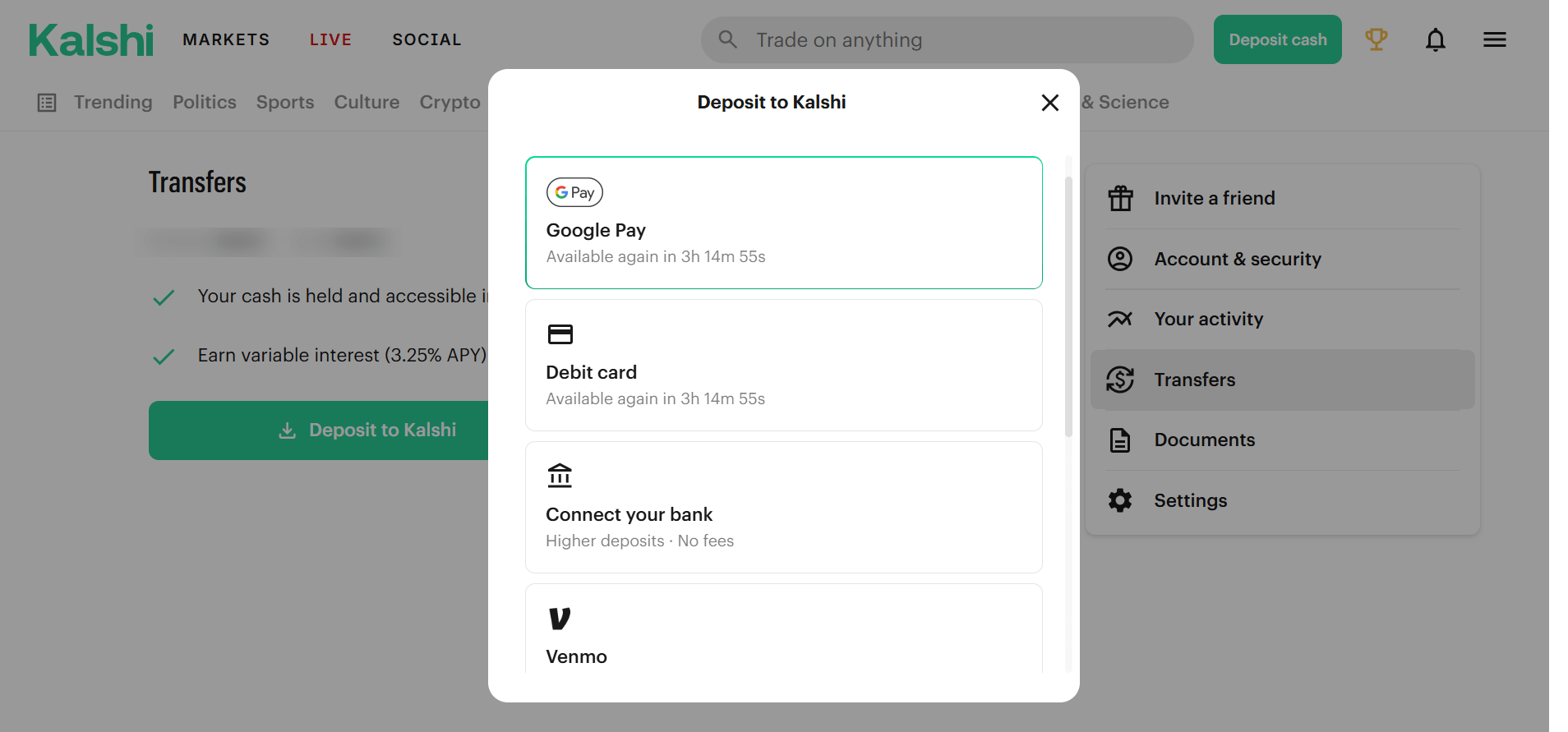
Kalshi's funding process is straightforward once you understand the hold period structure. I typically use ACH transfers for larger amounts since there's no processing fee, though the 1-3 day wait can be frustrating when I want to jump on breaking news. Debit cards offer instant funding but the 2% fee adds up quickly, I only use debit when I need immediate access to a time-sensitive market. The crypto option via Zero Hash is interesting for traders who already hold USDC, though the 30-minute processing window and third-party fees make it less appealing than ACH for most situations.
The biggest pain point is withdrawal holds. After funding via debit card, I have to wait 3 days before cashing out, which can lock up winnings if markets resolve quickly. The 90-day hold for withdrawing to a different bank account is exceptionally restrictive compared to other prediction market sites.
Accepted Payment Methods:
- ✅ Debit card (US-issued only, 2% processing fee)
- ✅ ACH bank transfer (via Aeropay, no fee from Kalshi)
- ✅ Cryptocurrency (USDC via Zero Hash, third-party fees may apply)
- ✅ Wire transfer (no Kalshi fee, bank fees may apply, $1,000 minimum)
- ❌ Credit cards (not supported)
- ❌ PayPal, Google Pay, Apple Pay (not currently available for deposits despite some user confusion)
| Method | Processing Time | Fees |
|---|---|---|
| Debit Card | Instant | 2% processing fee |
| ACH Transfer | 1-3 business days | $0 |
| Crypto (USDC) | Up to 30 minutes | Third-party processor fees disclosed before transaction |
| Wire Transfer | Within 1 business day if received by 4pm ET | $0 from Kalshi (your bank may charge) |
Funding Limits: Debit card deposits have a daily limit that varies by user verification level. ACH transfers typically support larger amounts but include hold periods before you can cash out to a different bank. Crypto deposits are capped at $500,000 per transaction. Wire transfers under $1,000 are not accepted.
Available Cash-Out Methods: ACH bank transfer, debit card redemption, cryptocurrency (USDC), wire transfer for balances over $500,000.
Withdrawal Processing Times: Debit card cash-outs typically complete within 30 minutes after the hold period clears. ACH withdrawals take approximately 3-4 business days. Crypto withdrawals process based on blockchain confirmation times.
Withdrawal Requirements: Kalshi enforces hold periods based on your funding method. Debit card deposits trigger a 3-day hold before you can cash out. Bank transfers create a 7-day hold if withdrawing to the same bank, or up to 90 days if withdrawing to a different bank account. KYC verification including ID submission and SSN confirmation is required before your first withdrawal.
How to Cash Out from Kalshi
1. Navigate to your Account section from the main menu
2. Select the "Withdraw" or cash-out option
3. Choose your preferred redemption method (ACH, debit card, or crypto)
4. Enter the amount you want to cash out
5. Confirm your details and submit the request
6. Wait for processing based on the method selected and any applicable hold periods
Fees & Pricing Structure
Kalshi's fee structure is more transparent than most unregulated prediction markets, though it's also more complex than traditional sportsbooks. The platform charges trading fees based on a formula rather than a flat percentage, which means your actual fee varies depending on contract price and quantity. I appreciate that Kalshi publishes the exact formula and provides example calculations, it removes the guesswork that plagues other platforms.
The general trading fee formula (effective October 1, 2025) is: fees = round up(0.07 × C × P × (1 − P)) where P equals the contract price in dollars and C equals the number of contracts. For maker orders that add liquidity to the order book, the formula becomes: round up(0.0175 × C × P × (1 − P)).
Here's a real-world example: If I buy 100 contracts at $0.50, the calculation is 0.50 × (1 - 0.50) = 0.25, then 100 × 0.25 = 25, then 25 × 0.07 = 1.75, rounded up to $1.75 in fees. This structure means fees are highest when contracts trade near $0.50 (maximum uncertainty) and lowest near $0.01 or $0.99 (high certainty).
| Fee Type | Kalshi | Polymarket | PredictIt |
|---|---|---|---|
| Trading Fee | Formula-based: 0.07 × C × P × (1 − P) | $0 (platform fee) | 10% on profits |
| Deposit Fee | $0 (ACH/Wire), 2% (Debit), Varies (Crypto) | $0 (gas fees apply for crypto) | $0 |
| Withdrawal Fee | $0 (ACH), $2 (Debit), Varies (Crypto) | $0 (gas fees apply for crypto) | 5% on withdrawals |
| Inactivity Fee | $0 | $0 | $0 |
Kalshi charges no settlement fees, no membership fees, and no inactivity fees. The platform also operates a volume incentive program that rewards high-frequency traders with a share of a monthly reward pool, though specific tier breakdowns and reward percentages are not published publicly.
Smooth and Sensible UI: A Look at One of the Best Prediction Market Apps
Website & Desktop Experience
Kalshi's desktop interface feels purpose-built for active trading. The layout prioritizes the order book, showing real-time bids and asks with size and price depth that helps me evaluate liquidity before placing orders. Navigation is clean, I can move between Markets, Portfolio, and Account sections without hunting through nested menus. The search function works well for finding specific contracts, though browsing by category (Sports, Politics, Economics) is equally intuitive.
Market pages load quickly even with multiple charts and real-time price updates. I particularly like the portfolio dashboard, which aggregates my open positions with current market value and unrealized profit/loss. The data visualization tools include basic price charts with historical movement, but they lack the technical indicators and advanced charting found on platforms like Interactive Brokers ForecastEx. Order placement is smooth, limit orders are easy to set and modify, and fills appear almost instantly when I take existing liquidity.
The biggest desktop weakness is the lack of customization. I can't rearrange dashboard modules, create watchlists with custom groupings, or set advanced price alerts for specific contract thresholds. For traders who want a more personalized workspace, this rigidity can feel limiting.
Mobile App Experience
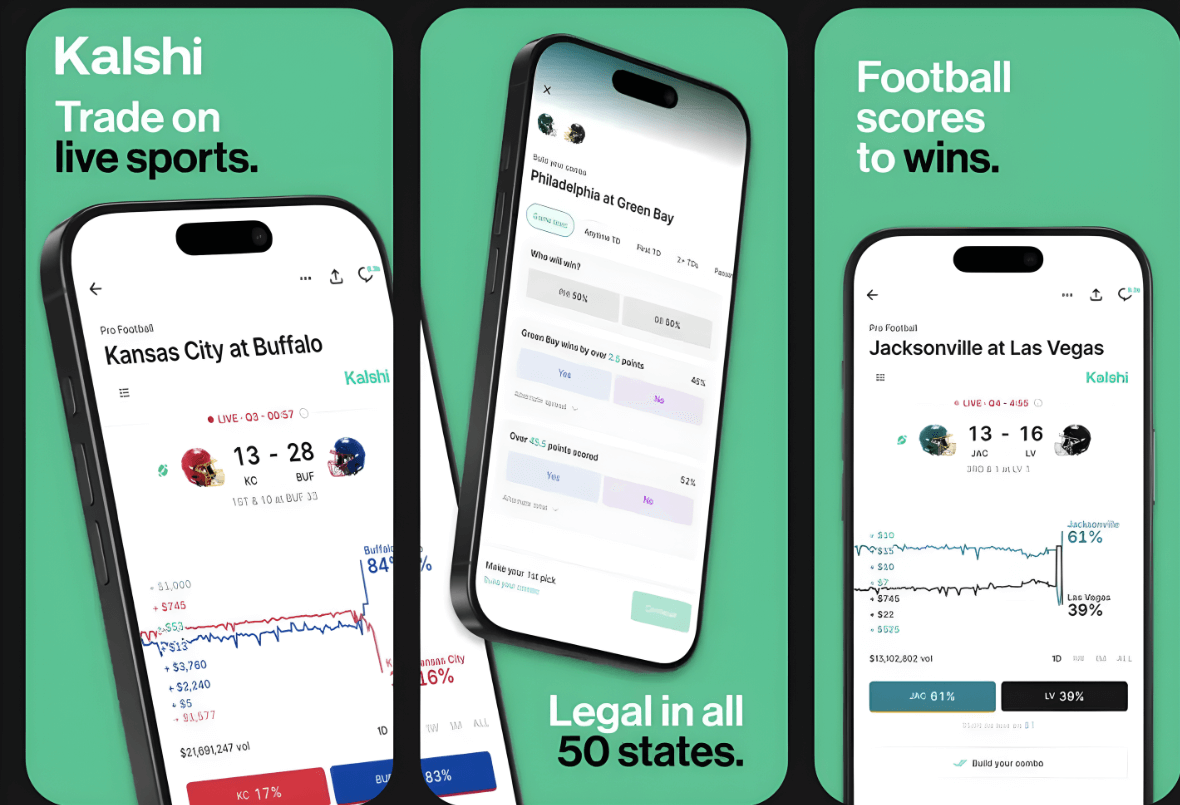
I've been trading on Kalshi's iOS app for several months, and it's become my preferred way to access the platform. The app opens in under a second on my iPhone 15, market pages load instantly, and chart-heavy views stay smooth even when scrolling through dozens of active contracts. The design is high-contrast with a deep navy background and bright accent colors that remain crisp on OLED screens in varying light conditions.
Order entry is exceptionally responsive. Prices and sizes update in real time as I adjust my position, and toggling between Yes and No contracts feels tactile thanks to light haptic feedback. The app handled network transitions well during my testing, switching between Wi-Fi and 5G without freezing or forcing a reload. At worst, I saw a brief spinner during refresh cycles.
The iOS app currently holds a 4.6-star rating on the App Store based on over 8,000 reviews (as of February 2026). Android users report similar performance on Google Play, though some reviews mention occasional lag on older devices. Mobile-specific features include Face ID authentication for quick login and push notifications for market updates, though notification customization is limited compared to dedicated finance apps.
I prefer trading on mobile for quick position adjustments and market monitoring, but I switch to desktop when I need to analyze multiple contracts simultaneously or review detailed portfolio performance. The mobile app lacks split-screen functionality and advanced filtering options that would make it truly competitive with desktop for heavy research.
Overall Platform Usability Rating: 8/10
Kalshi's platform excels at core trading functions with fast execution, clean design, and reliable mobile performance. The lack of advanced customization and technical analysis tools prevents it from reaching elite status, but for most news-driven traders and beginners, the interface provides everything needed without overwhelming clutter.
Kalshi Restricted States
Kalshi's availability varies significantly by state due to ongoing legal challenges around sports-related event contracts. The platform operates under federal CFTC regulation, but individual states have asserted authority to restrict certain contract types under state gaming laws. This creates a fragmented user experience where your location determines which markets you can access.
U.S. States with Full Access (46 states): CA, NY, TX, FL, GA, WA, VA, PA, OR, MN, WI, MA, NC, SC, AL, AK, AR, ID, IN, IA, KS, KY, LA, ME, MS, MO, NE, NM, ND, OK, SD, TN, UT, VT, WV, WY
Limited Access (Certain Contracts Restricted):
- ❌ Arizona
- ❌ Illinois
- ❌ Maryland
- ❌ Michigan
- ❌ Montana
Active Legal Challenges (Primarily Sports Contracts):
- ❌ New Jersey
- ❌ Ohio
- ❌ Colorado
- ❌ Nevada
These restrictions stem from state regulators arguing that Kalshi's sports contracts function as gaming products that require state-level oversight, conflicting with Kalshi's federal CFTC designation as a derivatives exchange. Massachusetts recently issued a preliminary injunction barring Kalshi from offering sports contracts in the state, and California tribes have filed cease-and-desist actions claiming Kalshi infringes on their exclusive tribal gaming rights.
If Kalshi is forced to geofence more than 10 states by Q3 2026 due to ongoing legal battles, analysts predict a "liquidity crater" that could significantly impact market depth and pricing efficiency. Traders in restricted states may want to consider federally compliant alternatives, though options are limited. FanDuel Predicts operates under state sports betting licenses in certain jurisdictions but offers a much narrower range of contract types.
International Availability: Kalshi restricts access from 46 countries and regions, including the United Kingdom, Canada, Australia, France, Singapore, Taiwan, Thailand, and all comprehensive U.S. sanctions jurisdictions (North Korea, Iran, Cuba, Syria, Russia, Belarus, and specified regions of Ukraine). The platform is available in most of Asia, Latin America, and Africa, with notable access in Mexico, Brazil, Germany, India, Japan, South Korea, and South Africa.
Is Kalshi Legit?
Yes, Kalshi is legitimate and operates as the first federally regulated prediction market in the United States. The platform received CFTC designation as a Designated Contract Market (DCM) and maintains a registered derivatives clearing organization (DCO) for settlement infrastructure. This regulatory framework places Kalshi in a fundamentally different category than unregulated offshore platforms or decentralized prediction markets that operate without government oversight.
Regulatory Oversight
Kalshi is regulated at the federal level by the U.S. Commodity Futures Trading Commission under the Commodity Exchange Act. The CFTC issued an Order of Designation to KalshiEX LLC, granting it DCM status, and the platform is listed as "Designated" in CFTC public filings. This means Kalshi must comply with rules-based market operations, maintain clearing infrastructure for settlement and risk management, and submit to market integrity controls around fair trading practices.
The platform does not hold state-level gaming licenses because it operates under federal derivatives law rather than state gambling statutes. This creates ongoing friction with state regulators, particularly around sports contracts, but it also means Kalshi benefits from federal preemption arguments that unregulated platforms cannot claim.
Security Measures
Kalshi implements multi-layer security controls to protect user funds and personal information. Customer funds are segregated in dedicated U.S. bank accounts and are not used for operational expenses or company capital. Collateral supporting open positions is treated separately within the clearing infrastructure. This segregation creates a legal firewall between user deposits and company assets.
Account security includes mandatory KYC verification requiring government-issued ID, Social Security number confirmation, and address verification before first withdrawal. The platform uses SSL/TLS encryption for data transmission and offers two-factor authentication (2FA) for login protection. Banking integrations rely on established partners like Aeropay for ACH transfers and Zero Hash for crypto custody, adding institutional-grade infrastructure layers.
Position limits cap maximum loss exposure on many contracts at $25,000 per member, preventing excessive risk concentration and supporting market stability during volatile news events. Withdrawal security includes method-based hold periods (3 days for debit, 7-90 days for ACH) and occasional additional verification checks for large cash-outs.
Responsible Trading Features
Kalshi's responsible trading tools are basic but functional. The platform offers deposit limits that users can set within their account settings, though the interface doesn't prominently feature these controls during signup. Self-exclusion options are available by contacting customer support, but there's no one-click cool-off period or automated time-out feature accessible directly from the dashboard. The help center links to problem gambling resources like the National Council on Problem Gambling, but these resources are buried in support articles rather than displayed on trading pages.
Compared to regulated sportsbooks with mature responsible gaming programs, Kalshi's tools feel underdeveloped. The platform would benefit from proactive features like real-time loss tracking warnings, mandatory deposit limit prompts for new users, and easier access to self-exclusion controls.
Final Verdict on Legitimacy: Kalshi is safe to use for traders comfortable with federal regulatory oversight and transparent risk structures. The CFTC designation provides meaningful legal protections and operational accountability that unregulated platforms lack. However, the ongoing state-level legal challenges create uncertainty around long-term market availability, particularly for sports contracts.
Customer Support
Kalshi's customer support operates primarily through email and a self-service help center, which creates frustration when I need immediate assistance with time-sensitive trading issues. The main contact method is [email protected], where the platform asks users to include account details and screenshots for faster troubleshooting. I've found response times highly variable, ranging from under 5 minutes for simple verification questions to over 3 days for complex withdrawal hold inquiries.
| Support Channel | Availability | Response Time |
|---|---|---|
| Email ([email protected]) | 24/7 submission, business hours response | 5 minutes to 3+ days (highly variable) |
| Help Center / FAQ | 24/7 | Instant (self-service) |
| Live Chat | Not available | N/A |
| Phone Support | Not available | N/A |
| Discord / Telegram | Not officially supported | N/A |
Social Media Presence: Kalshi maintains active accounts on Twitter/X (@KalshiMarkets), Instagram, and LinkedIn, primarily for market updates and company news rather than customer support. Direct messages on these platforms are not monitored for support requests.
The help center is comprehensive and well-organized, with detailed articles covering deposits, withdrawals, hold periods, fee calculations, and security verification. I appreciate the step-by-step formatting and explicit "Not publicly stated" notes when information is unavailable, this transparency is rare among prediction market platforms. However, the lack of live chat or phone support is a significant weakness, especially compared to other prediction market apps.
Support Quality Rating: 6/10
When Kalshi support responds, the quality is generally good with knowledgeable agents who understand the platform's technical details. The problem is consistency, urgent issues can sit unresolved for days while simple questions get rapid responses. The reliance on email-only support creates unnecessary friction for active traders who need real-time help during market hours.
Kalshi Real Player Reviews
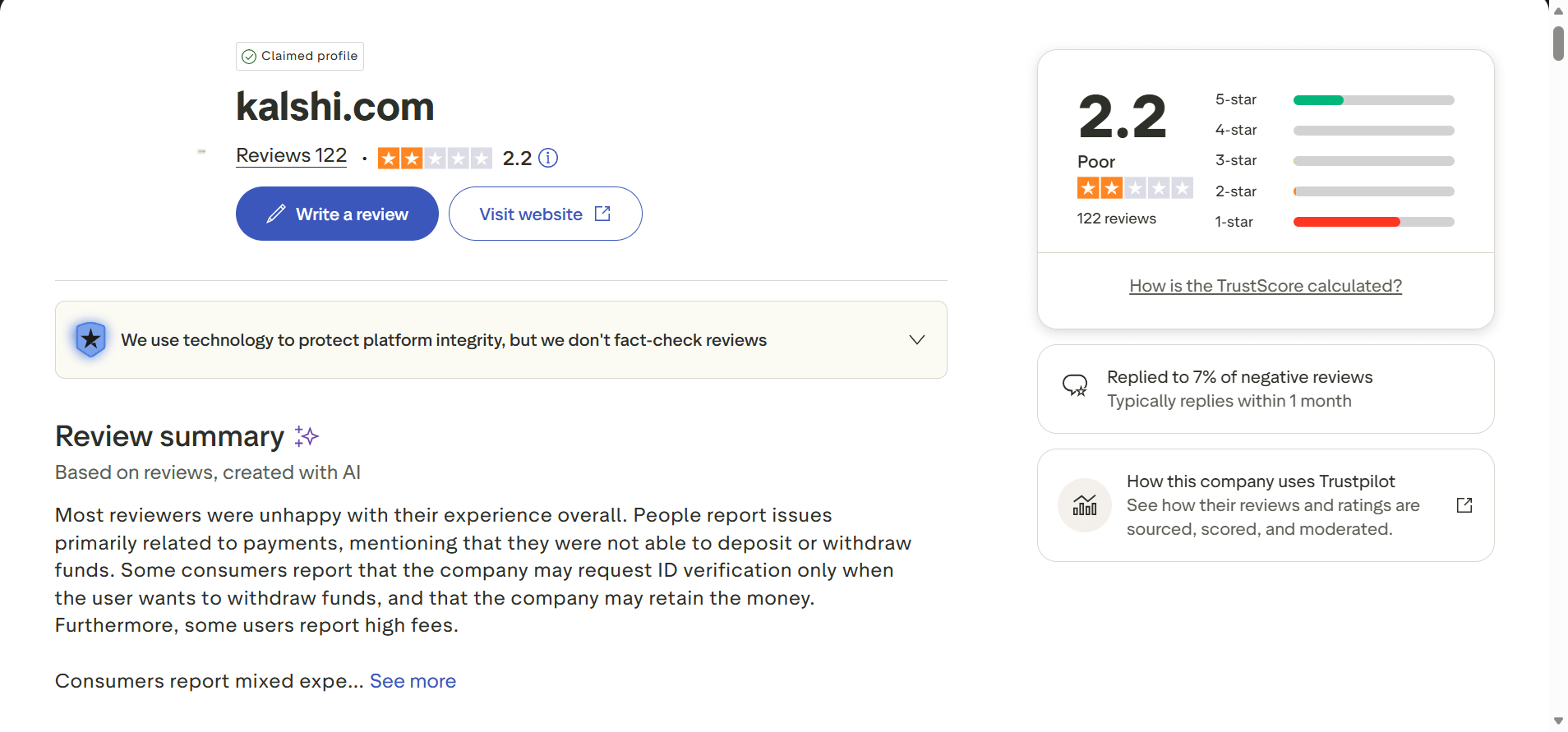
Kalshi's public reputation is mixed, with strong praise for platform performance and regulatory legitimacy tempered by frustration over withdrawal holds, verification delays, and inconsistent customer support. I reviewed feedback from Trustpilot, Reddit, App Store reviews, and Google Play to capture the current user sentiment as of February 2026.
Positive Reviews:
"Joe helped me and was very friendly. And personally, as someone in customer service as well, I feel like he hit all the goals he should have. Amazing feedback, responses, and even questions." – Trustpilot user, February 2026
"Easy app to navigate and awesome referral program! App moves really fast & I love that, no waiting game for results, bets or money!" – Trustpilot user, February 2026
"The customer support team is incredibly helpful with any and all issues. They go out of their way to help resolve the problem." – Trustpilot user, February 2026
"Kalshi hosts such a fun and legit market. It's generally easy to use and absolutely worth a try." – App Store review, December 2025
Negative Reviews:
"Terrible support! One simple question took 3 days or more to answer, and the supporter only use nonsense responses, they never actually can help. Very bad support ever." – Trustpilot user, February 2026
"I wish I could give them a zero. They did not pay out on their introductory offer. Their support was not helpful. Their site goes down when you want to track anything." – Trustpilot user, February 2026
"This experience with Kalshi was basically a scam. Their payouts do not calculate correctly and it is very difficult to withdraw money even after waiting days for settlements." – Trustpilot user, February 2026
"I've signed up for a Kalshi account and CAN NOT even fund it. They say you can fund your account by PayPal debit card but you can't. Customer support sucks." – Trustpilot user, February 2026
Overall Reputation Summary: Kalshi's general reputation online is emerging and mixed. Power users who understand the regulatory framework, fee structure, and hold periods tend to rate the platform highly for legitimacy and execution speed. New users frequently encounter friction around funding confusion (PayPal and digital wallets are not actually supported despite some marketing references), verification delays that block withdrawals, and slow support responses. The platform's Trustpilot rating reflects this divide, with enthusiastic 5-star reviews from satisfied traders balanced by frustrated 1-star reviews from users who hit withdrawal or verification roadblocks.
What I Thought Trading on Kalshi
I've been trading on Kalshi for about four months now, primarily focusing on political and economic markets where I follow news closely enough to spot mispriced contracts. What I like most is the transparency, the published fee formulas, explicit settlement rules, and CFTC oversight create a level of trust that's impossible to replicate on unregulated platforms. When I place an order, I know exactly what I'm paying in fees and how settlement will work, there's no mystery math or hidden bookmaker edge.
The trading interface itself is solid. Order execution is fast, I've never experienced slippage beyond what's visible in the order book, and fills appear almost instantly when I take existing liquidity. The mobile app has become my daily driver for quick position checks and order adjustments. I appreciate the clean design and responsive performance, it feels professional rather than gamified.
What could be improved? The withdrawal hold periods are my biggest frustration. I understand the anti-fraud rationale, but waiting 7 to 90 days to cash out to a different bank account is excessive compared to modern fintech standards. I've also hit situations where market liquidity dried up completely on niche contracts, leaving me unable to exit positions before settlement. This illiquidity risk is inherent to prediction markets, but Kalshi's smaller user base compared to Polymarket exacerbates the problem on less popular markets.
Customer support is inconsistent. When I've had simple questions about fee calculations or contract rules, I've received detailed email responses within hours. But when I needed help with a verification delay that blocked a withdrawal, I waited three days for a generic response that didn't actually resolve the issue. The lack of live chat or phone support feels antiquated for a platform handling real money.
I'd recommend Kalshi for three types of traders: news junkies who want to trade on breaking political or economic events with legitimate regulatory oversight, sports traders comfortable with exchange-style pricing instead of sportsbook odds (and willing to accept ongoing state-level legal uncertainty), and macro-focused traders who value transparent settlement and published risk limits. If you want sportsbook simplicity with parlays and bookmaker-set lines, stick with traditional betting apps. If you prioritize zero fees and international access over regulatory compliance, Polymarket is the better choice.
Compared to other platforms I've used, Kalshi sits in a unique middle ground. It's more regulated and transparent than Polymarket, but less liquid on many markets. It's more sophisticated than PredictIt, but also more expensive due to trading fees rather than flat profit commissions. It's faster and more focused than Interactive Brokers ForecastEx, but lacks the institutional-grade research tools and customer support infrastructure.
Final Score: 7/10
Comprehensive, AI driven ratings system:
Funded Peaks rates prediction market apps on a scale of 1-10, covering five basic categories: Bonuses, Markets, Fees, User Experience and Security
If a predictions platform scores 6 or lower on a category, we suggest alternatives for a better experience (orange bubble)
FP Score — Kalshi
FP GOLD
Browse through our top sweepstakes picks


